Who doesn’t want feedback?

I believe everyone wants to be successful, no matter the task; I don’t know anyone who wants to fail. What we really want is to know how to be successful; we want effective feedback.

I’m experiencing this school year both as a teacher and as a student. It enables me to reflect on teaching and learning from both perspectives. Recently, I’ve been reflecting on feedback.

One of the most effective strategies to improve student achievement, according to John Hattie’s Visible Learning for Teachers  research study, is feedback. When my students complete an assignment or finish a test, they anxiously wait for their grade, but feedback at the end is sometimes too late.

As a student in a principal licensure program, I agonized over my first assignment. There was no exemplar, and I wasn’t really sure what the expectations were even though I had clear instructions. I wondered how my work would compare with that of others in my cohort, and I wondered if I was on the right track. Moments after I submitted my work, I began anxiously waiting for some kind of feedback. When it came, I looked straight to the comments…not to the grade.

As a student, what I crave is feedback along the way that helps me succeed.

Grant Wiggins seemed to read my mind in his ASCD article entitled, Seven Keys to Effective Feedback. His description of the essentials of good feedback captures just what I want as a student:

megaphone2I want my feedback to be timely, ongoing, and consistent.
I want my feedback to be goal-referenced, actionable, and tangible.
I want my feedback to be specific and personalized, just for me.

As a teacher, this year I will focus on:

  • more frequent goal-setting
  • more formative assessment
  • more frequent personal conferencing
  • more timely feedback during the learning process
  • more progress monitoring and charting or graphing of results
  • more visual representations, such as timelines or ladders of skills
  • more opportunities to compare work in progress with exemplars

As a teacher, I owe it to my students to empower them with effective feedback…and I’ll even ask them to empower me with feedback, too!

If we were to meet again…what I would say to the new teacher I met on the train.

She was a special education teacher from New York, who sat next to me on a train after running the Boston Marathon. She described her training and the perseverance it took to make it through to race day. Then we began talking about teaching…in my mind, I was thinking that anyone who takes on running marathons certainly has what it takes to be a teacher! As we chatted more, she shared some of her first-year experiences as a co-teacher in an inclusion classroom. It became clear to me that she loved her students, but she was discouraged and disenchanted with the teaching profession. She felt unsupported and overwhelmed; she was ready to quit.

I thought about this chance meeting for a few days. It caused me to reflect on my own early experience and to think seriously about the importance of supporting and empowering new teachers. We need to be able to pass the torch to the bright young professionals of the future. These are my afterthoughts and my advice to the new teacher I met on the train.

1) Find a great mentor. If the district does not assign one, then seek out someone who cares enough about the profession to nurture it and support new members. Sometimes the match is less than ideal, and it is ok to also find others with whom you are more comfortable. Look outside your school and find online communities too – support and encouragement is everywhere.

2) Work on building relationships. Make connections with students, parents, colleagues, and administrators. A strong network is important for a rewarding career. Surround yourself with colleagues who are enthusiastic, positive, and willing to share.

3) Reflect often and focus on what works. Keep a record of the little successes each day. Revel in your students’ “Aha!” moments and the positive growth you see.

4) Forgive yourself for mistakes and that which does not work as expected. Anticipate the ups and downs and roll with them. There will be days when nothing seems to go as planned and lessons fall flat.  Step back, regroup, and use your reflections to make changes.

5) Be flexible. There will be days of last-minute changes and surprises. A new student may show up at your door without warning. Every day and every year will be different. Sometimes you need to grab a teachable moment and run with it. That’s what keeps it interesting!

6) Keep the whole child in mind – especially if you work with students with special needs. Sometimes educator impact and student growth cannot be documented accurately through test data or measured by academic goals. The social and emotional growth you witness is important too.

7) Share your knowledge and ideas. Believe in your ability to bring something new to the table, and don’t be intimidated by veteran staff. Your youth and energy are a valuable asset.

8) Observe other teachers in their classrooms as much as possible. Take note of organization, classroom management strategies, and routines. Take time to solidly establish routines that work for you in your classroom and you might find the teaching part becomes easier.

9) Look beyond the walls of your school and develop your own personal learning network. The best professional development is self-driven. Go to workshops, conferences, and EdCamps, and use the resources online through Twitter and educational blogs – you can find information on anything! And don’t be afraid to take a risk and try something new.

10) Indulge in your outside passions. Run your marathons and climb your mountains; challenge yourself outside of the classroom. It is easy to let the responsibilities of teaching consume your energy.  Give yourself permission to put it all aside at the end of the day and enjoy your other life.

Most importantly – keep a sense of humor and have fun!

What would you say to a new teacher?

Testing…testing

“Personally, if you want to know about my reading, it would be better to have me read a book out loud to you and answer some questions and talk about it and do that several times. That would be way nicer and way easier.”
~8th grade student

High-stakes testing looms large in classrooms in the spring. All year, we focus on Universal Design for Learning and Project Based Learning. We personalize learning, encourage collaboration, and attempt to use more authentic assessments. Yet, in the end students still are asked to perform on a standardized test.

This week I watched my students take the English Language Arts MCAS. They were afforded the appropriate approved IEP accommodations, and I began the week feeling positive and hopeful that they would fare well – that didn’t last long.

Students with slow processing and weak working memory do best when tasks are broken down into short, manageable chunks and scaffolded. Those with language-based learning disabilities benefit from a small prompt or clarification. Students with emotional difficulties perform best with flexibility, encouragement, and timely positive feedback. In fact, all students do, but none of this can happen on test days.

On test days, I can only stand back and watch my students plug away at arbitrary tasks, working hard for an unknown evaluator. The struggle shows on their faces and in their body language: they sigh a lot and fidget; they slump down in their seats; they rub their eyes; and they put their heads on their desks. Some even scribble angrily. Slower readers work for three and four hours. Instead of a true measure of learning, I watch it become a test of stamina and perseverance.

Todd Rose talks about the impact of perceived threat on working memory and performance. With this in mind, I invited my students to share their thoughts before the test session began: “Describe how you feel at this moment, as you sit down to take this test.”

“What if I don’t do good?”
“I’m probably gonna fail this.”
“What if I can’t read the words?”
“What if I don’t understand it?”
“I’m afraid I won’t know what to write.”
“My mom’s gonna be really mad if I don’t do good.”
“It’s like way too serious, like you are doing bills or taxes.”
“It’s so scary and intimidating, like it’s going to the president or something.”

I work all year building confidence in my students and being a cheerleader. While I recognize the premise of standardized assessments, when I hand out these tests I can’t help feeling like a saboteur. I would love to see the day when we assess students more authentically, as proposed twenty-five years ago by Grant Wiggins and as suggested to me this week by an astute eighth grader.

What teachers think about

Considering research and recommendations for effective teaching, there is quite a lot for teachers to think about and incorporate into their practices each day – in fact, enough to fill the month of March, and probably more!

 ~ 31 self-reflection questions ~

 (These float around in my mind and I share them in no particular order. Links added were chosen out of personal interest for professional reference or resources to explore. )

  1. How do I build relationships to meet the emotional needs of my students?
  2. How do I consider neurodiversity in my teaching?
  3. How do I ask good questions to promote critical thinking and comprehension?
  4. How do I design authentic assessments?
  5. How do I accurately monitor progress using curriculum-based-measurement?
  6. How do I choose research-based strategies for interventions?
  7. How do I differentiate instruction?
  8. How do I use technology effectively?
  9. How do I teach executive functioning skills to my students?
  10. How do I collect evidence for the new educator evaluation?
  11. How do I evaluate student learning and  student growth?
  12. How do I set high expectations for all students?
  13. How do I incorporate 21st Century Skills in my lessons?
  14. How do I communicate effectively with parents?
  15. How do I collaborate with colleagues and learn from peers?
  16. How do I establish a fully accepting and inclusive classroom?
  17. How do I design lessons that focus on abilities not disabilities?
  18. How do I manage flexible grouping and tiered levels of support?
  19. How do I challenge and enrich students?
  20. How do I foster a growth mindset?
  21. How do I build resiliency in students?
  22. How do I individualize, differentiate, or personalize learning?
  23. How do I plan backward with Understanding by Design?
  24. How do I write SMART goals for standards-based IEPs?
  25. How do I teach meta-cognitive skills?
  26. How do I empower my students with self-directed learning?
  27. How do I practice visible assessing with goal-setting and self-reflection?
  28. How do I use formative assessments to inform instruction?
  29. How do I give high quality feedback every day?
  30. How do I support self-regulation and social skills development?
  31. How do I use research and feedback to change and improve my teaching?

What have I forgotten? What resources would you recommend? What do you think about?

Assistive technology: a change in perspective

My job title is “special education teacher” and I teach “students with special needs.”

My students’ abilities move about the continuum of learner variability, depending upon the lens being used to evaluate them. For over ten years, I’ve armed them with “assistive technology” and written it as an accommodation in their Individual Education Plans. It was necessary to facilitate inclusion. The goal has always been to provide access to curriculum, especially when it involved reading and writing. That goal hasn’t changed, but now there is a changing perception of the tools my students are using.

Years ago, software like Kurzweil, built-in text-to-speech capability of computers, and audio versions of text were useful, but these also made students stand out. They were usually the only ones doing something differently, and sometimes they resisted. Who wants to be the only kid in the room using a computer to read and write? Students with special needs don’t necessarily want to make themselves look different.

Along came Universal Design for Learning, Blended Learning, and a 1:1 iPad initiative to our middle school. As time went on, more students were doing things differently. Lessons created with Universal Design contain options for representation, engagement, and expression of learning. Teaching to the margins as the norm has helped our students with special needs blend in. With the addition of Blended Learning and 1:1 devices, no longer is it just special education teachers accommodating a few students with assistive technology. By allowing and providing options for everyone, no one looks different.

UDL and technology together help include all students; the possibilities are endless.

Varied reading ability has less impact on learning outcomes when technology empowers students. A colleague recently said, “It all goes back to the learning goal, doesn’t it?” So simple and so true. If the learning goal is understanding content, and students have the choice of listening to and following highlighted text, then the challenges are diminished. We can take the disability out of the curriculum by planning ahead and providing digital text as an option. Why not let every student choose from technology options if the essential question relates to content understanding, not learning to read?

Students can focus on content when information is represented using online textbooks, resources like Bookshare.org, and iPad apps like Read2Go and Subtext. These options have made my students more engaged and more active classroom participants.

IMG_0080

Varied communication, executive functioning, and writing ability has less impact on performance when technology empowers students. If the learning goal is demonstrating understanding, and students have the choice of creating a screen cast, a video, a slide, or an e-book, then some challenges are diminished. For students with organizational, motor or expressive language difficulties, is there a benefit to struggling through writing a traditional essay when options like creating an Infographic, storyboard, or slide allow them to better show what they know?

My students have been successful using iPad apps like Popplet and Tools4Students to organize ideas. Book Creator,  iMovie, ScreenChomp, Educreations, Explain Everything, and ThingLink increase their engagement and enable them to demonstrate learning.

There will always be students with a variety of needs in any educational environment. When considering inclusion, the concept of empowering – rather than assisting – students with technology, promotes a shift from focusing on disability to focusing on ability.

UDL and technology together make special education feel a little more general.

I’ve seen the amazing things my students with special needs CAN do. I would be quite happy someday just being called a “teacher,” who teaches “students.”

Can words empower?

Research on teaching and learning empowers me with ideas to consider in my classroom.

In Visible Learning for Teachers, Maximizing Impact on Learning (2012), John Hattie reports findings on factors that influence student learning. Student expectations – self assessment – self grading was the identified as one that had the greatest impact on student growth. Given this, providing my students with frequent, varied opportunities for self-assessment and self-reflection makes sense.

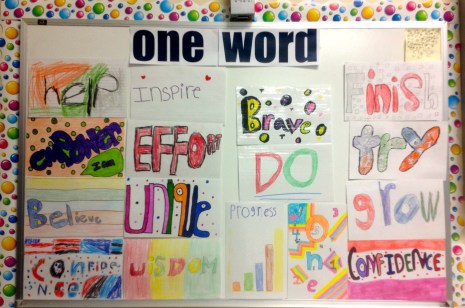
When the New Year rolled in, I was looking for inspiration and a way to start on a positive note. I wanted an alternative to the traditional New Year’s Resolution and goal setting. Thanks to many online postings, I discovered myoneword.org. Here was a simple activity and an opportunity for students to self-reflect.

After some discussion, the students personally assessed their overall school performance during the first half of the school year. They chose a word that summed up what they wanted to strive for the rest of the year. Anyone who knows these students well would be able to match each chosen word to its owner; their personal insight never ceases to amaze me.

one word(Click the image to see our Thinglink!)

Students have taken ownership of their words. They have posted them in their lockers, written them in binders and notebooks, and turned them into screen savers. This week, they reflected how their word connected to math class performance during the month of January and written an entry on their math blogs.

“Well in math class when it was Jan. I was scared to say my answer in class because I did not want to get it wrong so I would never show my answer! So I picked the word brave because I need to be brave in class. Now it’s February and I am not as scared as I was in Jan.!”

“I believed in myself and did good on a test the other day. Now in February I shall do the same!!! “😊

“I was confident in math in January. And I got 100 in multiplication because I was confident in my work.”

We will continue to revisit the words for the rest of the year and do other kinds of more academic self-assessment. While this is not exactly self-grading, I hope that in just a few minutes each week my students will become more empowered learners through their own self-reflection, and this will help lead to growth – all driven by a word.

Please share your ideas on strategies for developing empowered learners!

First thoughts

DSCN0412.JPG - Version 2

As a special education teacher, I am always seeking inspiration.

I have been a longtime consumer of ideas and resources that other educators share online, and I am always amazed by what I find when I go searching. The more I read, the more I recognize the importance of being connected outside of the school community, for both teachers and students, as we move deeper into the 21st century.

This year, I tried something new. I set up blogs for my students, intending to give them a platform for creating, connecting, and sharing, but some were hesitant. It finally dawned on me that to help my students I also needed to step outside my classroom and become more connected myself. As I ventured out, I discovered Twitter and Personal Learning Networks, and I became intrigued by the possibilities. My latest step is the creation of this blog.

I envision this as a place to reflect on the mountain of information, initiatives, and change in education that just keeps growing: Common Core…Educator Evaluation…Universal Design for Learning…Educational Technology…Personalized Learning…Understanding By Design…Data and Assessment…Differentiated Instruction…Response To Intervention…Executive Functioning, and more. Add these to supporting Inclusion and I am usually so focused on climbing up the mountain that I forget to stop and glance back.

Teaching academic concepts and skills to middle school students with varied abilities is part of my job. Of course my students are empowered by knowledge, however I believe that if I can empower them in other ways too, then their progress and their success in the future will be even greater.

My goal is for my students to be confident, independent, critical thinkers. I want them to have resources and strategies at their disposal to help them succeed at whatever they choose to do. I want them to become informed, to practice self-advocacy, and to be proactive. Despite their struggles, my students are a collection of wonderful collaborators, gifted speakers, and technology wizards; they are inquisitive, creative, and reflective. I want them to believe in themselves, to have a growth mindset, and to persevere. I teach with the belief that this is possible for all learners.

Of course, my opinions here are my own…and they are subject to change at any time. I hope that, as I continue to learn, I will change my practice when it is the right thing to do. I also hope to keep in step with my students. Teaching and learning is a journey, and we are on this road together.