Assistive technology: a change in perspective

My job title is “special education teacher” and I teach “students with special needs.”

My students’ abilities move about the continuum of learner variability, depending upon the lens being used to evaluate them. For over ten years, I’ve armed them with “assistive technology” and written it as an accommodation in their Individual Education Plans. It was necessary to facilitate inclusion. The goal has always been to provide access to curriculum, especially when it involved reading and writing. That goal hasn’t changed, but now there is a changing perception of the tools my students are using.

Years ago, software like Kurzweil, built-in text-to-speech capability of computers, and audio versions of text were useful, but these also made students stand out. They were usually the only ones doing something differently, and sometimes they resisted. Who wants to be the only kid in the room using a computer to read and write? Students with special needs don’t necessarily want to make themselves look different.

Along came Universal Design for Learning, Blended Learning, and a 1:1 iPad initiative to our middle school. As time went on, more students were doing things differently. Lessons created with Universal Design contain options for representation, engagement, and expression of learning. Teaching to the margins as the norm has helped our students with special needs blend in. With the addition of Blended Learning and 1:1 devices, no longer is it just special education teachers accommodating a few students with assistive technology. By allowing and providing options for everyone, no one looks different.

UDL and technology together help include all students; the possibilities are endless.

Varied reading ability has less impact on learning outcomes when technology empowers students. A colleague recently said, “It all goes back to the learning goal, doesn’t it?” So simple and so true. If the learning goal is understanding content, and students have the choice of listening to and following highlighted text, then the challenges are diminished. We can take the disability out of the curriculum by planning ahead and providing digital text as an option. Why not let every student choose from technology options if the essential question relates to content understanding, not learning to read?

Students can focus on content when information is represented using online textbooks, resources like Bookshare.org, and iPad apps like Read2Go and Subtext. These options have made my students more engaged and more active classroom participants.

IMG_0080

Varied communication, executive functioning, and writing ability has less impact on performance when technology empowers students. If the learning goal is demonstrating understanding, and students have the choice of creating a screen cast, a video, a slide, or an e-book, then some challenges are diminished. For students with organizational, motor or expressive language difficulties, is there a benefit to struggling through writing a traditional essay when options like creating an Infographic, storyboard, or slide allow them to better show what they know?

My students have been successful using iPad apps like Popplet and Tools4Students to organize ideas. Book Creator,  iMovie, ScreenChomp, Educreations, Explain Everything, and ThingLink increase their engagement and enable them to demonstrate learning.

There will always be students with a variety of needs in any educational environment. When considering inclusion, the concept of empowering – rather than assisting – students with technology, promotes a shift from focusing on disability to focusing on ability.

UDL and technology together make special education feel a little more general.

I’ve seen the amazing things my students with special needs CAN do. I would be quite happy someday just being called a “teacher,” who teaches “students.”

Can words empower?

Research on teaching and learning empowers me with ideas to consider in my classroom.

In Visible Learning for Teachers, Maximizing Impact on Learning (2012), John Hattie reports findings on factors that influence student learning. Student expectations – self assessment – self grading was the identified as one that had the greatest impact on student growth. Given this, providing my students with frequent, varied opportunities for self-assessment and self-reflection makes sense.

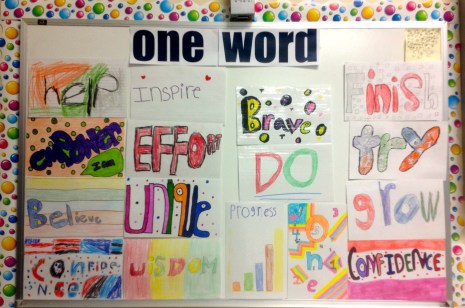
When the New Year rolled in, I was looking for inspiration and a way to start on a positive note. I wanted an alternative to the traditional New Year’s Resolution and goal setting. Thanks to many online postings, I discovered myoneword.org. Here was a simple activity and an opportunity for students to self-reflect.

After some discussion, the students personally assessed their overall school performance during the first half of the school year. They chose a word that summed up what they wanted to strive for the rest of the year. Anyone who knows these students well would be able to match each chosen word to its owner; their personal insight never ceases to amaze me.

one word(Click the image to see our Thinglink!)

Students have taken ownership of their words. They have posted them in their lockers, written them in binders and notebooks, and turned them into screen savers. This week, they reflected how their word connected to math class performance during the month of January and written an entry on their math blogs.

“Well in math class when it was Jan. I was scared to say my answer in class because I did not want to get it wrong so I would never show my answer! So I picked the word brave because I need to be brave in class. Now it’s February and I am not as scared as I was in Jan.!”

“I believed in myself and did good on a test the other day. Now in February I shall do the same!!! “😊

“I was confident in math in January. And I got 100 in multiplication because I was confident in my work.”

We will continue to revisit the words for the rest of the year and do other kinds of more academic self-assessment. While this is not exactly self-grading, I hope that in just a few minutes each week my students will become more empowered learners through their own self-reflection, and this will help lead to growth – all driven by a word.

Please share your ideas on strategies for developing empowered learners!

First thoughts

DSCN0412.JPG - Version 2

As a special education teacher, I am always seeking inspiration.

I have been a longtime consumer of ideas and resources that other educators share online, and I am always amazed by what I find when I go searching. The more I read, the more I recognize the importance of being connected outside of the school community, for both teachers and students, as we move deeper into the 21st century.

This year, I tried something new. I set up blogs for my students, intending to give them a platform for creating, connecting, and sharing, but some were hesitant. It finally dawned on me that to help my students I also needed to step outside my classroom and become more connected myself. As I ventured out, I discovered Twitter and Personal Learning Networks, and I became intrigued by the possibilities. My latest step is the creation of this blog.

I envision this as a place to reflect on the mountain of information, initiatives, and change in education that just keeps growing: Common Core…Educator Evaluation…Universal Design for Learning…Educational Technology…Personalized Learning…Understanding By Design…Data and Assessment…Differentiated Instruction…Response To Intervention…Executive Functioning, and more. Add these to supporting Inclusion and I am usually so focused on climbing up the mountain that I forget to stop and glance back.

Teaching academic concepts and skills to middle school students with varied abilities is part of my job. Of course my students are empowered by knowledge, however I believe that if I can empower them in other ways too, then their progress and their success in the future will be even greater.

My goal is for my students to be confident, independent, critical thinkers. I want them to have resources and strategies at their disposal to help them succeed at whatever they choose to do. I want them to become informed, to practice self-advocacy, and to be proactive. Despite their struggles, my students are a collection of wonderful collaborators, gifted speakers, and technology wizards; they are inquisitive, creative, and reflective. I want them to believe in themselves, to have a growth mindset, and to persevere. I teach with the belief that this is possible for all learners.

Of course, my opinions here are my own…and they are subject to change at any time. I hope that, as I continue to learn, I will change my practice when it is the right thing to do. I also hope to keep in step with my students. Teaching and learning is a journey, and we are on this road together.